
M-Guard diffusion treatment
Greater hardness at the surface.
M-Guard is a standalone diffusion treatment exclusively for moulds and tools in plastics processing. It can be used without a PVD coating or combined with a compatible PVD coating.
DIFFUSION TREATMENT FOR PLASTIC MOULDS
Effective in the surface zone.
Flexible combinations.
M-Guard increases the surface-zone hardness of moulds and tools in plastics processing through diffusion. The treatment can be used without a PVD coating or combined with one of six compatible PVD coatings. M-Guard itself does not apply a separate coating.
mirror-polished · brushed · textured · blasted · EDM-finished
These terms describe the condition of the tool or mould surface.Hardness compared.
A soft heat-treatable steel retains its core properties. With M-Guard, its surface zone reaches a hardness far above that of through-hardened tool steel.
Steel values from data sheets, approximately converted to HV. M-Guard achieves up to 1,400 HV, depending on the material.
M-Guard without a PVD coating
The hardened surface zone is a standalone treatment for your plastics tooling. A PVD coating is not required. After the M-Guard treatment, the surface is repolished.
Explore polishing Enquire about M-GuardM-Guard with a PVD coating
For plastics applications, M-Guard can be followed by one of these six PVD coatings. We tailor the choice to the tool steel, surface and application.
M-Guard is treated at 380–440 °C. Each PVD coating has its own coating temperature.
Enquire about this combinationSCRATCH TEST
One sample,
two halves.
The mirror-polished disc is divided down the middle: the left half is only polished, while the right half also receives M-Guard treatment. The same scriber, the same pressure.
- Left the scriber leaves visible grooves in the bare steel. Every contact leaves a mark.
- Right it slides over the hardened surface zone. The polish remains unchanged.
This is what happens in mouldmaking during insertion, cleaning and setup. With M-Guard, a mirror-finished surface withstands everyday handling without repolishing.
TYPICAL APPLICATIONS
Where M-Guard
makes the difference.
Applications in plastic mouldmaking where the hardened surface zone helps keep the tool in service. We assess which applies to your tool based on the material and application.
Mirror-finished moulds in everyday use
Insertion, cleaning, setup: the hardened surface zone withstands contact that would otherwise leave scratches. Light marks can be repolished without orange-peel texture. Repair welding remains possible.
Explore polishingMoulds with pore formation
When carbides break out of the steel, pores appear in the polished surface. Prepolishing, M-Guard and repolishing strengthen the surface zone and limit further breakout in service. This keeps a mirror-finished mould in use instead of replacing it.
Mould surface repair serviceAbrasive plastics
From approximately 20% glass fibre, the melt abrades the cavity. Here we combine M-Guard with a PVD coating such as InNOVA PM: the coating withstands abrasion and the strengthened surface zone beneath supports it.
Explore PVD coating
M-Guard diffusion treatment in detail.
M-Guard modifies the properties of the near-surface zone by diffusion. Unlike PVD or DLC, no separate coating is applied to the tool. The treatment is used exclusively for moulds and tools in plastics processing whose functional surfaces need greater wear resistance while retaining the existing polish, texture or EDM structure as a design requirement. For these less hardened or pre-hardened steels, the nitriding hardness depth is 0.2–0.3 mm. PLUS is used for stamping, forming and die casting. Through-hardened tool steels with a tempering temperature above 500 °C are required. Its nitriding hardness depth is 0.02–0.05 mm.
- Surface hardness up to 1,400 HV, depending on the steel
- Nitriding hardness depth (NHD) 0.2 to 0.3 mm
- Treatment temperature from 380 to 440 °C
- Followed by repolishing and, if required, PVD coating
- For mirror-polished and line-polished surfaces
- Also for textured, blasted and EDM surfaces
- No dimensional allowance: mould geometry, dimensions and detail are preserved
- Repairability is maintained: repolish, reblast and weld without stripping
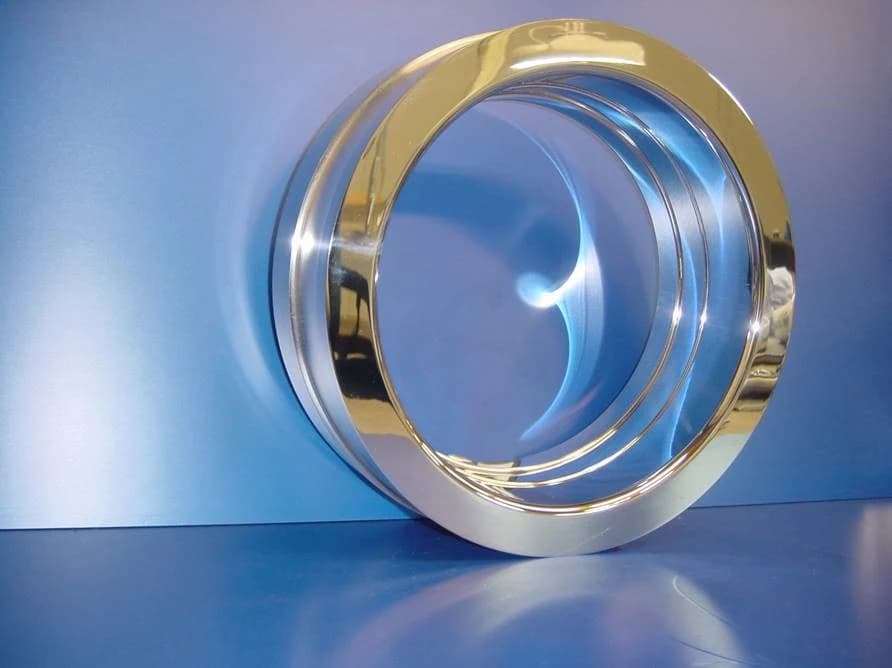
Standalone treatment. Further finishing as needed.
M-Guard refers to the diffusion treatment itself. It is followed by repolishing. An additional PVD coating can be applied if required.
For polished mould surfaces, M-Guard can improve the conditions for a successful polishing result. For plastics applications, M-Guard can be combined with a suitable PVD coating. We assess the suitability of further processing based on the material, surface condition and application.
Combining polishing, M-Guard and PVD coating from one source pays off in production: high-gloss parts release more easily, surface quality lasts without repolishing, and plastic flows more uniformly, reducing visible weld lines. The result is less maintenance and a more stable process.
THE NEXT STEP